EventCore
A system that records real-world events — QR scans, NFC taps, sensor readings, GPS positions or manual input — and turns them into live views and reports.
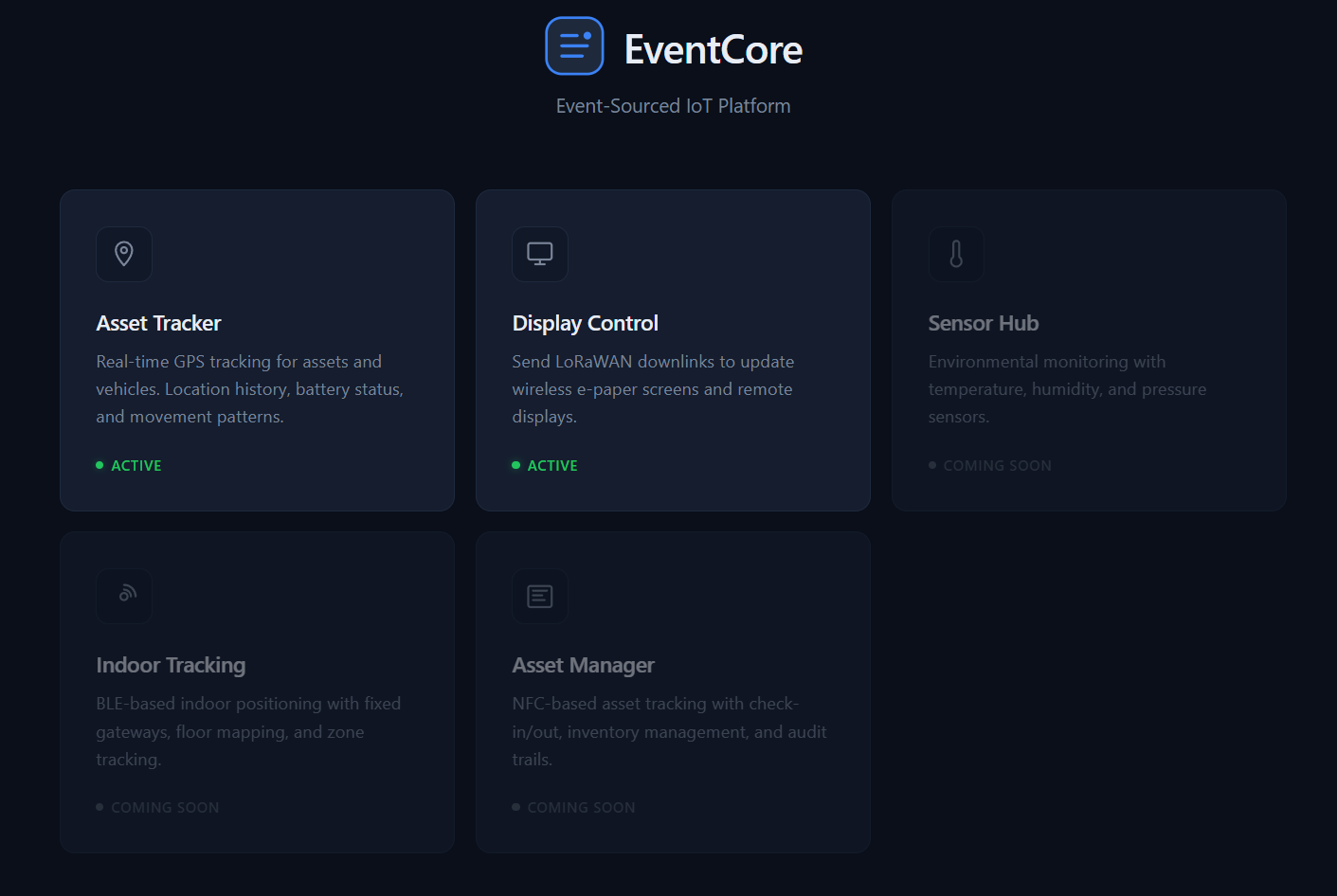
Problem
Small operations run on events: something moved, something was scanned, a limit was crossed, someone pressed a button. Most software that could capture those moments assumes two things — permanent cloud connectivity, and data living on someone else's servers.
Those assumptions fail in a lot of real places. On farms, vineyards, forestry plots, construction yards and private industrial sites, mobile coverage is weak or patchy. And even where connectivity is fine, many operators simply prefer that movement data, sensor readings and operational records stay on their own ground.
EventCore is my answer to that gap: one system that records events from whatever source fits the site, shows the current state of everything, and produces the reports the operation needs — connected to the cloud where that makes sense, or running entirely on-site where it does not.
Outcome
- A working prototype that ingests GPS positions from long-range LoRa nodes and shows the live state of every device on a map.
- Runs in the cloud or fully on-site, depending on privacy, connectivity and how independent the operator wants to be.
- One event model covers locations, scans, sensor readings, device states, alerts and small remote commands — a new use case does not need a new system.
- Range tests on open land give a credible basis for farms, vineyards, forestry and private yards where mobile coverage is weak, expensive or unwanted.
Stack
Rust (event-sourced backend, runs self-contained on a small server) · LoRaWAN via ChirpStack (MQTT) · LoRa P2P (direct serial) · PostgreSQL (append-only event log) · Heltec LoRa nodes (GPS tracker, stick, e-paper display)
What EventCore does
EventCore records the moments that matter in a physical operation and turns them into a live picture, workflows and reports.
An event can be almost anything. A guard reaches a checkpoint and scans a QR code. A reusable container comes back and taps an NFC reader. A cold room crosses a temperature limit. A tractor enters a field. A worker presses “done” on their phone. Different sources, same shape: something happened, somewhere, at some time, to some thing.
EventCore stores every one of those events reliably and projects them into whatever view the operation needs: where everything is right now, what state it is in, what happened last Tuesday night, and which numbers belong in the monthly report. The inputs are flexible — QR codes, NFC cards, sensors, GPS trackers, manual entry — and the output is always the same thing: an answer you can act on.
What works today
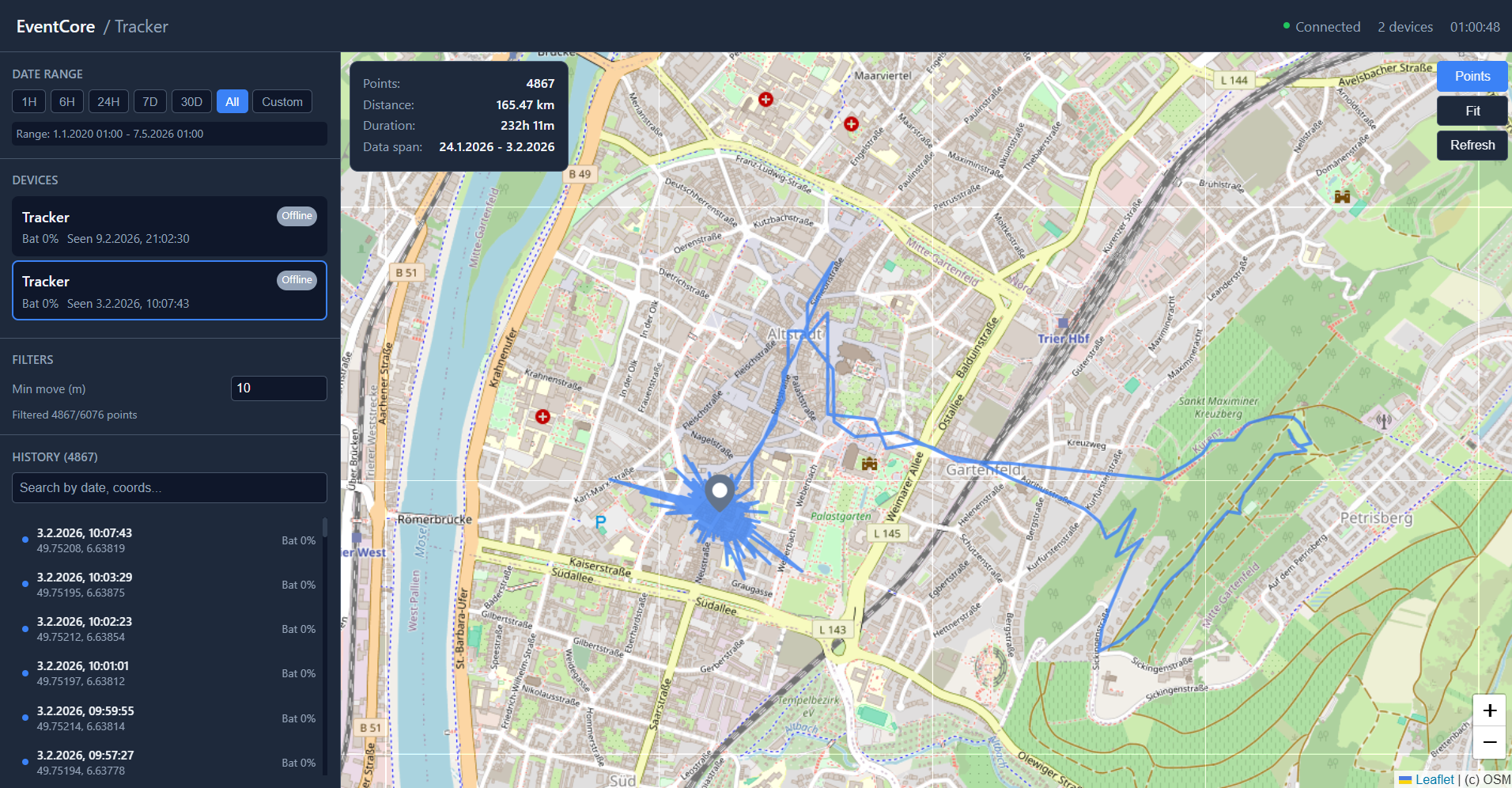
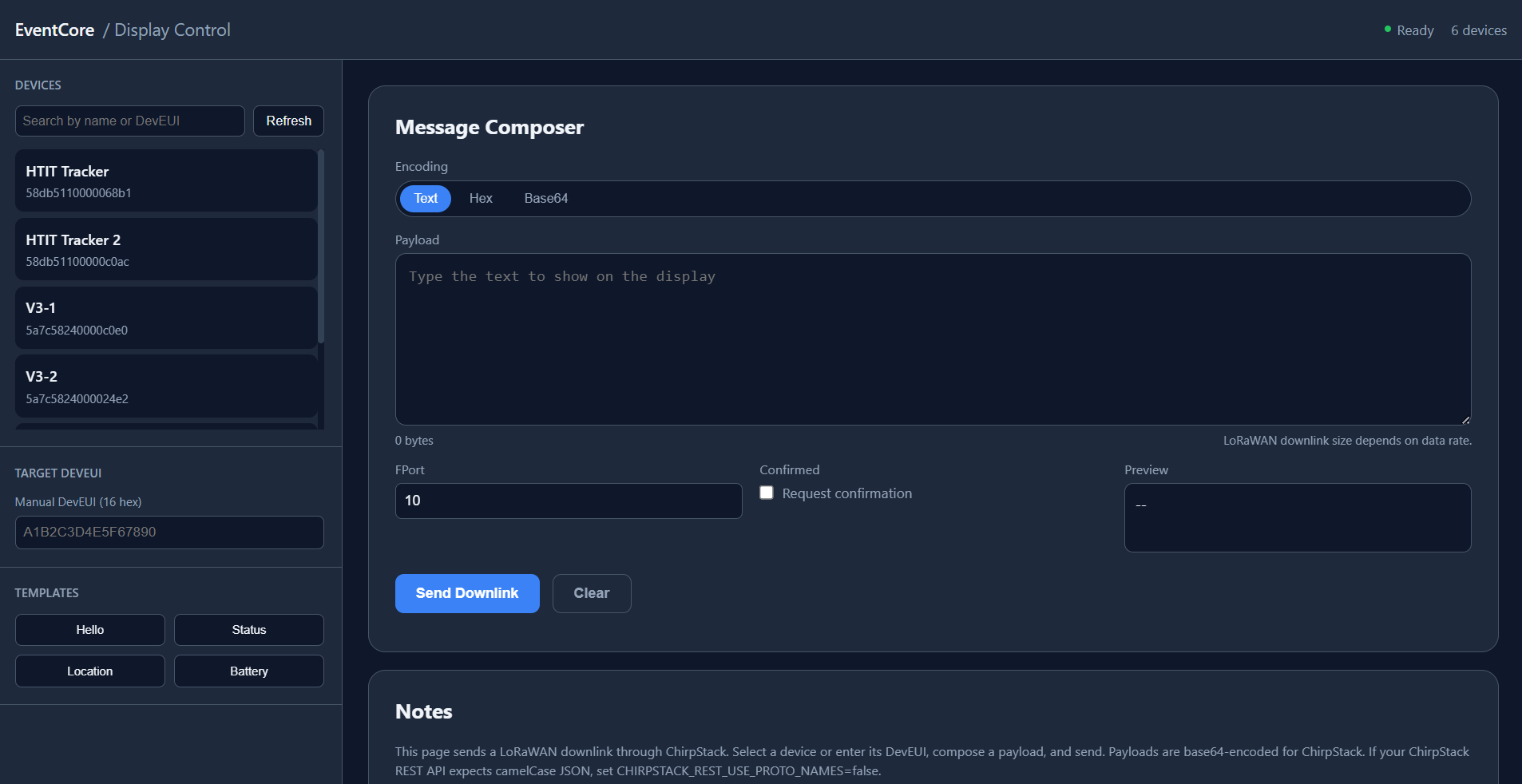
The current prototype tracks GPS positions. Small battery-powered LoRa nodes report their location over kilometres of open land, the backend records each position as an event, and a live map shows where every device is and how it got there. Commands also flow the other way: the system can update a node’s e-paper display or trigger a small action in the field, which makes it a light command-and-state layer rather than a passive tracker.
Range tests with prototype hardware confirmed the part that matters for real sites: with an open environment and a well-placed gateway, this works far beyond indoor distances — on exactly the kind of land where mobile coverage is weak, expensive or unwanted.
One honest boundary: this is not phone-style live GPS tracking, and it is not meant to be. It is long-running, low-power monitoring where the value is knowing that something happened, where it happened, and what state things are in now.
Cloud or fully on-site
The whole backend runs either hosted or on a small server on the operator’s own site, next to their own radio gateway, with no data leaving the property. For privacy-conscious businesses in Germany and Europe that is not a technical footnote — it is often the feature that makes the project acceptable at all.
The communication side is just as flexible: LoRa where the land is wide and power is scarce, 4G or Wi-Fi where updates need to be richer, wired sensors inside a building. The choice of radio never changes the system.
How it is built, briefly
The backend is written in Rust as an event-sourced system: every incoming event is appended to a permanent log before anything else happens, and the live state is derived from that log. It ships as a single self-contained binary that runs unattended on a small on-site machine for months — which is precisely the job description. The stack details are listed above; the design goal is simpler to state: never lose an event, never need a person watching it.
What it could become
Nobody buys “a flexible event platform”, and I am not selling one. What a business buys is one narrow tool for one painful workflow — and EventCore is the machinery I build those tools from:
- A contractor attendance system for construction sites.
- A reusable-container tracking system (Tapaway is exactly this shape).
- A maintenance or inspection tool with proof of presence.
- A security patrol verification system.
- An event check-in and engagement system.
- Livestock, equipment and sensor monitoring on farms, vineyards and forestry land.
Each deployment is one visible product for one clear buyer and one painful workflow. If one of these shapes — or a cousin of one — matches a problem in your operation, get in touch. I would rather grow the next stage of EventCore around a real workflow than guess at one in the lab.